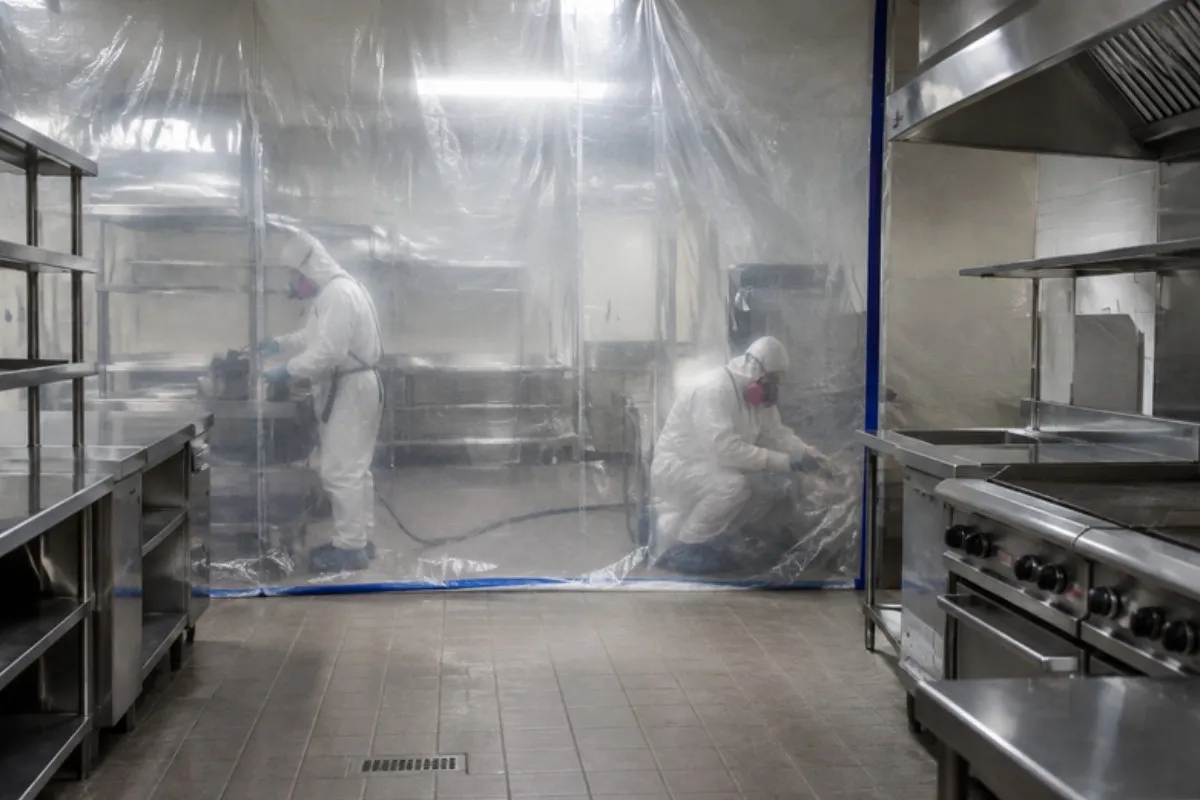
Commercial mold remediation in White House is aimed at buildings that need to stay open, such as offices, stores, churches and rental properties, while mold is removed. A good company works from a written scope, contains the area and follows EPA's commercial guidance. Call the number on this page to be connected with a local mold remediation company in White House.
Has flooding affected commercial buildings in White House?
Yes. White House is a growing suburb about 22 miles north of Nashville along I-65, and heavy rain has caused trouble more than once. On September 1, 2017, flooding closed Highway 31W and Highway 76 (Portland Road). On May 8, 2024, flash flooding put most of Tyree Springs Road underwater and sent water into part of White House High School, including some of the theater. That second event shows how quickly water can reach the inside of a large public building. Tennessee's Healthy Homes guidance warns that mold can begin within 48 hours of flooding, so drying has to start right away.
Which county office handles our permits?
For property inside city limits, the City of White House Planning and Codes department reviews building permit requests and does inspections, whether the address is on the Robertson or Sumner County side. Applications go through the city's EnerGov Customer Self-Service portal. Mold removal itself is not usually treated as permitted work, but rebuilding framing or structural parts afterward can be. The same department enforces the city's adopted 2021 property maintenance code, so tenants can use its Report a Concern link for unfixed leaks.
What should we ask about licensing?
For any project of $25,000 or more, Tennessee requires a contractor's license, and S-F is the classification for mold remediation. Splitting the work into phases does not get around that. For residential rental work between $3,000 and $25,000, the state Home Improvement license applies in Robertson County, one of the counties on TDCI's list, but Sumner County is not on that list, so the answer can depend on which side of the line the property sits. Confirm any company on TDCI's Verify a License search.

A local note
White House is growing fast, and newer commercial buildings are not immune to mold. Clogged AC condensate lines, roof penetrations around rooftop units and plumbing leaks in shared walls are common sources. EPA advises not running an HVAC system you suspect is contaminated, which may mean shutting down one zone while work is done. The Robertson County Health Department in Springfield can help with health questions.
Commercial Mold Remediation questions in White House
Who handles permits for repairs after the mold is removed?
Do we have to close the building while the work is done?
Should the building's HVAC keep running during remediation?
What license should a commercial mold contractor hold in Tennessee?
More mold services in White House
Commercial Mold Remediation nearby
Helpful guides
Sources
- EPA: Mold Remediation in Schools and Commercial Buildings (pdf)
- EPA: Mold Cleanup in Your Home
- Tennessee Contractor Classification Outline (TDCI)
- TDCI: Bidding FAQs
- TDCI: Bidding and Contractor License Requirements (pdf)
- Tennessee Department of Health: Healthy Homes
- Tennessee Department of Health: Local Health Departments
- White House, Tennessee (Wikipedia)
- Smokey Barn News: September 1, 2017 flooding
- NewsChannel 5: Flash flooding at White House High School (May 2024)
- City of White House: Planning and Codes
Last updated: